

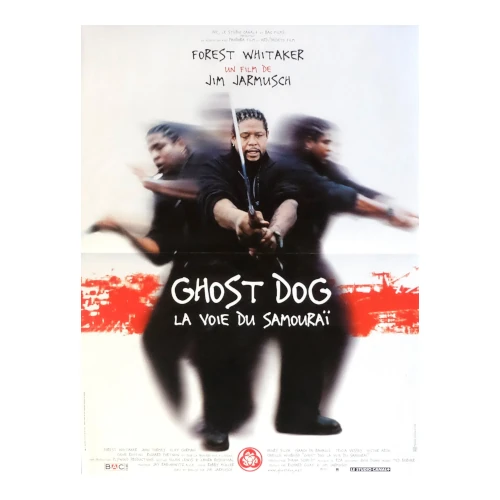


Septième long métrage de Jim Jarmusch, Ghost Dog : La Voie du samouraï est un film noir américain sorti en France le 6 octobre 1999, après une présentation en compétition officielle au Festival de Cannes la même année. Coproduction internationale réunissant les États-Unis, la France, l’Allemagne et le Japon, le film met en scène Forest Whitaker dans le rôle d’un tueur à gages afro-américain vivant à Jersey City selon les préceptes du Hagakure, le code d’honneur des samouraïs du Japon médiéval. Croisant le film noir, la philosophie orientale et la culture hip-hop, Ghost Dog explore des thématiques de loyauté absolue, d’obsolescence et de solitude dans une Amérique contemporaine hostile aux codes anciens.
Ghost Dog (Forest Whitaker) vit reclus sur le toit d’un immeuble abandonné de Jersey City, entouré de ses pigeons voyageurs. Tueur professionnel au service de la mafia italo-américaine locale, il se considère comme le vassal de Louie (John Tormey), le mafieux qui lui sauva la vie des années auparavant lors d’une agression. Guidé en toute chose par les aphorismes du Hagakure, Ghost Dog exécute ses contrats avec une rigueur monastique. Mais lorsque la fille du parrain Vargo (Henry Silva) est témoin de l’un de ses meurtres, les boss décident d’éliminer Ghost Dog pour protéger leur secret. Celui-ci se retrouve alors pris dans un engrenage fatal, poursuivi par les hommes au service de son propre maître, sans jamais remettre en question l’allégeance qui constitue le fondement même de son existence. Seul Raymond (Isaach de Bankolé), marchand de glaces ne parlant que français, demeure son unique ami — les deux hommes communiquant par-delà la barrière des langues avec une improbable et profonde compréhension mutuelle.
Le projet naît d’une fascination de longue date de Jarmusch pour Le Samouraï (1967) de Jean-Pierre Melville, dont Ghost Dog reprend ouvertement la figure du tueur solitaire régi par un code implacable — jusqu’à reproduire dans sa conclusion le geste fatalement délibéré du personnage de Delon. Forest Whitaker a déclaré avoir lui-même visionné le film de Melville en préparation de son rôle, y découvrant la vertu du silence. Jarmusch intègre également des références au cinéma de Seijun Suzuki et au roman Rashōmon d’Akutagawa, qui circule comme un talisman entre les personnages du film. La musique est confiée à RZA, membre fondateur du Wu-Tang Clan, qui signe ici ses débuts à l’écran dans un petit rôle : sa bande originale, mêlant hip-hop instrumental et nappes méditatives, structure le film comme un second souffle poétique. La photographie est assurée par Robby Müller, fidèle collaborateur de Jarmusch depuis Down by Law (1986). Le tournage se déroule à Jersey City et dans les environs de New York. Le film est produit avec un budget modeste de 2 millions de dollars.
Présenté en compétition officielle pour la Palme d’or au Festival de Cannes 1999, Ghost Dog y recueille un accueil largement favorable de la critique internationale, qui salue la cohérence formelle du projet et la performance habitée de Whitaker. Il est nommé à la fois à l’Independent Spirit Award du meilleur film et au César du meilleur film étranger en 2000. Avec environ 9,3 millions de dollars de recettes mondiales pour un budget de 2 millions, le film réalise un résultat commercial honorable pour une production indépendante de cette envergure. Il s’impose rapidement comme l’une des œuvres majeures de la filmographie de Jarmusch, régulièrement cité parmi les films de genre les plus singuliers des années 1990, et a fait l’objet d’une restauration 4K supervisée par le réalisateur, ressortie en salles françaises en décembre 2022.
The seventh feature film by Jim Jarmusch, Ghost Dog: The Way of the Samurai is an American crime drama released in France on October 6, 1999, following its official competition screening at the Cannes Film Festival that same year. An international co-production between the United States, France, Germany, and Japan, the film stars Forest Whitaker as an African-American hitman living in Jersey City according to the precepts of the Hagakure, the honor code of medieval Japanese samurai. Weaving together film noir, Eastern philosophy, and hip-hop culture, Ghost Dog explores themes of absolute loyalty, obsolescence, and solitude in a contemporary America hostile to ancient codes.
Ghost Dog (Forest Whitaker) lives in seclusion on the rooftop of an abandoned building in Jersey City, surrounded by his carrier pigeons. A professional killer in the service of the local Italian-American mob, he considers himself the vassal of Louie (John Tormey), the mobster who saved his life years earlier during an assault. Guided in all things by the aphorisms of the Hagakure, Ghost Dog carries out his contracts with monastic precision. But when the mob boss Vargo’s daughter (Henry Silva) witnesses one of his murders, the bosses decide to eliminate Ghost Dog to protect their secret. He finds himself caught in a fatal spiral, hunted by the men serving his own master, yet never once questioning the allegiance that forms the very foundation of his existence. Only Raymond (Isaach de Bankolé), an ice cream vendor who speaks only French, remains his sole friend — the two men communicating across the language barrier with an improbable and profound mutual understanding.
The project grew from Jarmusch’s long-standing fascination with Jean-Pierre Melville’s Le Samouraï (1967), from which Ghost Dog openly borrows the figure of the solitary killer governed by an unyielding code — going so far as to recreate in its conclusion the fatally deliberate gesture of Delon’s character. Forest Whitaker has stated that he watched Melville’s film in preparation for the role, discovering through it the virtue of silence. Jarmusch also wove in references to the cinema of Seijun Suzuki and to Akutagawa’s novel Rashōmon, which passes between characters like a talisman. The score was entrusted to RZA, founding member of the Wu-Tang Clan, who also makes his screen debut in a small role: his soundtrack, blending instrumental hip-hop with meditative textures, functions as a second poetic breath running through the film. Cinematography was handled by Robby Müller, Jarmusch’s longtime collaborator since Down by Law (1986). The film was shot in Jersey City and the surrounding New York area on a modest budget of $2 million.
Presented in official competition for the Palme d’Or at the 1999 Cannes Film Festival, Ghost Dog was warmly received by the international press, which praised the formal coherence of the project and Whitaker’s deeply inhabited performance. It received nominations for both the Independent Spirit Award for Best Feature and the César Award for Best Foreign Film in 2000. With approximately $9.3 million in worldwide box office receipts against a $2 million budget, the film achieved a respectable commercial result for an independent production of its scale. It rapidly established itself as one of the central works in Jarmusch’s filmography, regularly cited among the most singular genre films of the 1990s, and was the subject of a 4K restoration supervised by the director, rereleased in French cinemas in December 2022.


