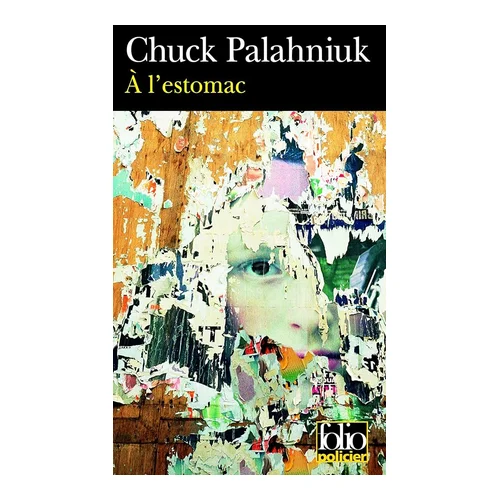
À l’estomac (Haunted en version originale) est un roman de Chuck Palahniuk publié en mai 2005 par Doubleday aux États-Unis, puis traduit en français par Alain Defossé et édité chez Gallimard la même année. Inclassable entre roman choral, recueil de nouvelles et fable noire, l’œuvre se déroule dans un théâtre abandonné où vingt-trois aspirants écrivains se retrouvent volontairement reclus. Palahniuk y pousse à l’extrême ses thèmes de prédilection — la communauté, la souffrance, le spectacle de soi-même — dans une exploration transgressive et satirique de la célébrité, du sacrifice et de la dégénérescence.
Vingt-trois personnages, attirés par une annonce promettant une retraite d’écriture de trois mois, se retrouvent enfermés dans un théâtre délabré sous la houlette du mystérieux Mr. Whittier. Coupés du monde et rapidement privés de ressources, ils sombrent dans une descente collective vers la violence, la faim et la folie — tout en sabotant méthodiquement leurs propres conditions de survie dans l’espoir de disposer, au moment des secours, d’une histoire suffisamment atroce pour les rendre célèbres. La structure du livre alterne un récit-cadre narré à la première personne du pluriel avec les nouvelles que chaque personnage — désigné par un surnom évocateur — raconte à ses compagnons de captivité. Ces histoires, à tonalité confessionnelle et souvent horrifiques, dessinent en creux les traumatismes, les obsessions et la vacuité d’une époque obsédée par la visibilité médiatique.
Palahniuk conçoit À l’estomac comme une œuvre capable de provoquer une réaction physique chez le lecteur, à la manière dont Shirley Jackson avait suscité le scandale avec La Loterie dans le New Yorker. La nouvelle liminaire, Guts, d’abord refusée par Playboy avant d’être finalement acceptée après la réaction du public lors d’une lecture à Barnes & Noble — où plusieurs dizaines de personnes s’étaient évanouies —, est publiée dans le numéro de mars 2004 du magazine avant la parution du livre. Palahniuk l’a lue lors de ses tournées promotionnelles dès 2003, comptabilisant méthodiquement le nombre d’évanouissements dans le public. L’œuvre s’inscrit dans la suite de Journal intime (2003) et marque une radicalisation formelle : le roman intègre des poèmes attribués à chaque personnage, des nouvelles autonomes et un récit-cadre, formant une architecture tripartite inédite dans sa bibliographie.
À sa sortie, À l’estomac suscite des réactions partagées : salué pour l’ambition de sa construction et la cohérence satirique de son propos sur la société du spectacle, il est également critiqué pour une surenchère perçue par certains comme une fin en soi. La nouvelle Guts acquiert rapidement une notoriété autonome — au total, 73 évanouissements sont répertoriés lors des lectures publiques, un chiffre que Palahniuk documente lui-même en postface. Un enseignant new-yorkais est même suspendu pour avoir fait lire le texte à ses élèves. Le roman demeure l’une des œuvres les plus commentées de Palahniuk en dehors de Fight Club, et l’une des plus représentatives de sa méthode : faire de l’inconfort physique du lecteur un vecteur de sens.
Haunted is a novel by Chuck Palahniuk, published in May 2005 by Doubleday in the United States and translated into French by Alain Defossé for Gallimard the same year under the title À l'estomac. Straddling the line between choral novel, short story collection, and dark fable, the book unfolds in an abandoned theater where twenty-three aspiring writers find themselves voluntarily confined. Palahniuk pushes his defining themes to extremes — community, suffering, the performance of selfhood — in a transgressive and satirical exploration of celebrity, sacrifice, and decay.
Twenty-three characters, lured by an advertisement promising a three-month writers' retreat, find themselves locked inside a dilapidated theater under the supervision of the mysterious Mr. Whittier. Cut off from the outside world and quickly deprived of basic resources, they spiral collectively into violence, starvation, and madness — all while systematically sabotaging their own survival conditions in the hope of emerging, when rescued, with a story harrowing enough to make them famous. The book alternates a framing narrative told in the first-person plural with the short stories each character — identified by an evocative nickname — tells to their fellow captives. These confessional, often horrific stories sketch the traumas, obsessions, and emptiness of an era defined by the hunger for media visibility.
Palahniuk conceived Haunted as a work capable of producing a physical reaction in its audience, in the tradition of the outrage Shirley Jackson provoked with The Lottery in The New Yorker. The opening story, Guts, was initially rejected by Playboy before being accepted following the public reaction at a Barnes & Noble reading — where dozens of people fainted — and published in the magazine's March 2004 issue ahead of the book's release. Palahniuk read it during promotional tours from 2003 onward, methodically tallying the number of audience members who lost consciousness. The work follows Diary (2003) and marks a formal radicalization: the novel integrates poems attributed to each character, standalone short stories, and a framing narrative, forming a tripartite architecture unprecedented in his bibliography.
Upon publication, Haunted received a divided response: praised for the ambition of its structure and the satirical coherence of its commentary on the society of spectacle, it was also criticized by some for a perceived excess that risked becoming an end in itself. The story Guts rapidly acquired a reputation of its own — a total of 73 fainting episodes were recorded at public readings, a figure Palahniuk himself documented in an afterword. A New York City teacher was suspended for assigning the text to high school students. The novel remains one of Palahniuk's most widely discussed works outside of Fight Club, and one of the most representative of his method: making the reader's physical discomfort a vehicle for meaning.