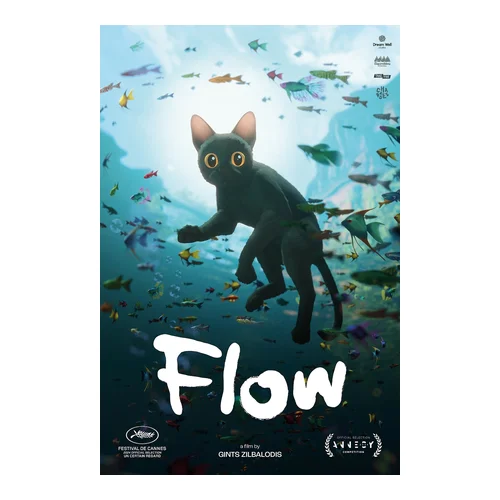

Sorti en France le 30 octobre 2024, Flow (Straume en letton) est un film d’animation d’aventure franco-belgo-letton réalisé par Gints Zilbalodis, coécrit et coproduit avec Matīss Kaža, en coproduction avec Sacrebleu Productions et Take Five pour un budget de 3,5 millions d’euros. Sans aucun dialogue, entièrement animé avec le logiciel libre et open source Blender, le film suit un chat solitaire confronté à une montée des eaux post-apocalyptique et contraint de partager un bateau avec d’autres animaux. Présenté dans la sélection Un Certain Regard au Festival de Cannes 2024, il devient l’une des œuvres les plus primées de l’année, consacré par l’Oscar, le César et le Golden Globe du meilleur film d’animation.
Dans un monde où l’humanité a disparu, un petit chat noir vit seul dans une forêt que la montée des eaux submerge peu à peu. Fuyant l’inondation, il trouve refuge sur un voilier dérivant déjà habité par plusieurs animaux : un capybara débonnaire, un lémur chapardeur, un grand oiseau blanc majestueux, et un chien enthousiaste. La cohabitation s’avère aussi difficile que la survie : le chat, animal solitaire par nature, doit apprendre à faire confiance, à collaborer, à se laisser toucher par la présence des autres. Le film suit ce groupe improbable à la dérive dans un monde englouti, entre séquences de tension pure et moments de grâce méditatifs, sans jamais recourir à la parole pour raconter ce voyage intérieur autant que géographique.
Gints Zilbalodis, réalisateur letton né en 1994, avait déjà réalisé son premier long métrage Away (2019) entièrement seul, de l’animation à la musique. Pour Flow, il travaille pour la première fois avec une équipe — les animations étant réparties entre des pôles à Paris, en Belgique et en Lettonie, sous la direction de l’animation assurée par Léo Silly-Pélissier. La production débute en 2019 et dure cinq ans et demi. Zilbalodis opte pour Blender, logiciel gratuit et open source, grâce à son moteur de rendu en temps réel EEVEE, qui permet d’obtenir une esthétique hybride mêlant la tridimensionnalité à un rendu graphique proche de la 2D stylisée. Sans storyboard traditionnel, il conçoit des animatiques qu’il envoie à ses équipes plan par plan. Il cite Jacques Tati et la série animée Future Boy Conan parmi ses références. Guillermo del Toro salue publiquement le film dès la publication du premier extrait.
Présenté en work-in-progress à Annecy en juin 2023, Flow remporte au Festival d’Annecy 2024 quatre prix, dont le Prix du jury, le Prix du public et le Prix de la meilleure musique originale. Il est ensuite présenté en avant-première mondiale à Cannes le 22 mai 2024 et sort en salles lettones le 29 août, devenant le film le plus vu de l’histoire du cinéma letton. En France, il cumule environ 700 000 entrées en trois mois. Avec un box-office mondial dépassant 50 millions d’euros pour un budget de 3,5 millions, il réalise l’une des performances commerciales les plus remarquables de l’animation indépendante européenne. Aux 97e Academy Awards, il remporte l’Oscar du meilleur film d’animation — battant des productions de grands studios comme Vice-Versa 2 — et reçoit également une nomination pour le meilleur film international, devenant la première production lettone à recevoir un Oscar. Il remporte aussi le César et le Golden Globe dans la même catégorie, faisant de Flow un événement sans précédent dans l’histoire du cinéma d’animation indépendant, et de Blender un outil désormais reconnu à l’égal des logiciels propriétaires des grands studios.
Released in France on October 30, 2024, Flow (Straume in Latvian) is a French-Belgian-Latvian animated adventure film directed by Gints Zilbalodis, co-written and co-produced with Matīss Kaža, in co-production with Sacrebleu Productions and Take Five on a budget of €3.5 million. Without any dialogue, entirely animated using the free and open-source software Blender, the film follows a solitary cat confronted by a post-apocalyptic flood and forced to share a boat with other animals. Presented in the Un Certain Regard selection at the 2024 Cannes Film Festival, it became one of the most awarded films of the year, crowned with the Oscar, César, and Golden Globe for Best Animated Feature.
In a world from which humanity has vanished, a small black cat lives alone in a forest progressively swallowed by rising waters. Fleeing the flood, it takes refuge on a drifting sailboat already inhabited by several animals: a good-natured capybara, a thieving lemur, a majestic large white bird, and an enthusiastic dog. Cohabitation proves as difficult as survival: the cat, solitary by nature, must learn to trust, to cooperate, to allow the presence of others to matter. The film follows this unlikely group adrift in a submerged world, alternating between sequences of pure tension and meditative moments of grace, never resorting to speech to tell a journey that is as interior as it is geographical.
Latvian filmmaker Gints Zilbalodis, born in 1994, had already made his first feature Away (2019) entirely alone, from animation to music. For Flow, he works with a team for the first time — animations distributed between hubs in Paris, Belgium, and Latvia, under the direction of lead animator Léo Silly-Pélissier. Production began in 2019 and lasted five and a half years. Zilbalodis chose Blender, a free open-source software, for its real-time renderer EEVEE, which produces a hybrid aesthetic blending three-dimensionality with a stylized near-2D graphic look. Without traditional storyboards, he created animatics that he sent to his teams shot by shot. He cites Jacques Tati and the anime series Future Boy Conan among his references. Guillermo del Toro publicly praised the film upon the release of its first clip.
Presented as a work-in-progress at Annecy in June 2023, Flow won four prizes at the 2024 Annecy International Animated Film Festival, including the Jury Prize, the Audience Award, and Best Original Score. It then had its world premiere at Cannes on May 22, 2024, and released in Latvian theaters on August 29, becoming the most-viewed film in Latvian cinema history. In France, it accumulated approximately 700,000 admissions in three months. With a worldwide box office exceeding €50 million against a €3.5 million budget, it achieved one of the most remarkable commercial performances in European independent animation. At the 97th Academy Awards, it won Best Animated Feature — defeating major studio productions including Inside Out 2 — and received a nomination for Best International Feature Film, becoming the first Latvian production to win an Oscar. It also won the César and Golden Globe in the same category, making Flow an unprecedented event in the history of independent animated cinema, and establishing Blender as a tool now recognized on equal footing with the proprietary software of major studios.