

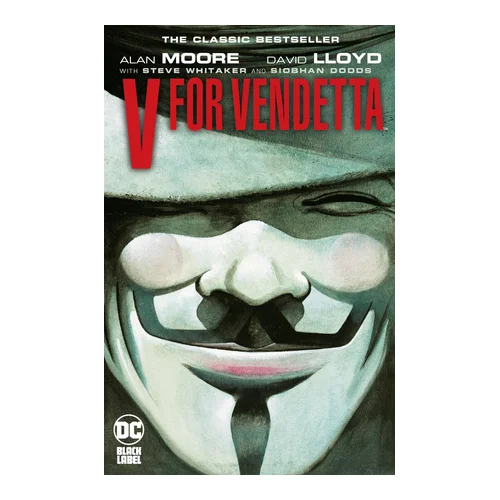


V pour Vendetta est un roman graphique britannique scénarisé par Alan Moore et illustré par David Lloyd, publié en intégrale en France en janvier 1999 aux éditions Delcourt dans la collection Contrebande, dans une traduction de Jacques Collin. L’œuvre se déroule dans une Angleterre uchronique fasciste des années 1990 — celle qui aurait pu exister après une catastrophe nucléaire mondiale — et suit la figure d’un mystérieux justicier masqué se faisant appeler V, dressé seul contre un régime totalitaire. Thriller politique, dystopie anarchiste et méditation sur la liberté individuelle, V pour Vendetta s’impose comme l’un des monuments fondateurs du roman graphique contemporain.
Londres, fin du XXe siècle. L’Angleterre est gouvernée par le Norsefire, un parti fasciste qui surveille, contrôle et élimine toute opposition : minorités ethniques, homosexuels, dissidents politiques sont envoyés dans des camps. Evey Hammond, jeune femme de seize ans sans ressources, est sauvée d’une agression par un homme masqué du visage ricanant de Guy Fawkes, coiffé d’un chapeau et d’une cape noire : V. Ce dernier vit reclus dans une cave-musée consacrée aux plus belles œuvres de la culture classique, et conduit depuis des années une guerre personnelle contre le régime — attentats symboliques, manipulations, assassinats ciblés parmi ceux qui l’ont, des années plus tôt, torturé dans un camp d’expérimentation. L’inspecteur Finch, chargé de traquer V, remonte peu à peu le fil d’une vérité plus complexe qu’il n’y paraît. Entre Evey, progressivement façonnée par V en héritière de son idéal anarchiste, et Finch, personnage traversé par ses propres doutes sur le système qu’il sert, Moore tisse une réflexion serrée sur la frontière entre terrorisme et résistance, entre anarchie et chaos.
La genèse de V pour Vendetta est longue et accidentée. C’est David Lloyd qui, le premier, impulse la direction artistique de l’œuvre : c’est lui qui propose le masque de Guy Fawkes — référence au conspirateur catholique de la Poudre (1605) — comme figure centrale du récit, et Lloyd qui convainc Moore de situer l’histoire en Angleterre plutôt qu’aux États-Unis, afin de dessiner Londres tel qu’il l’entend. Le titre lui-même vient de l’éditeur, Dez Skinn. La série paraît d’abord en strips en noir et blanc dans le magazine britannique Warrior entre 1982 et 1984, puis s’arrête avec la disparition du magazine en 1985, laissant l’histoire inachevée. En 1988, Karen Berger, éditrice du label Vertigo chez DC Comics, convainc Moore et Lloyd de reprendre et terminer la série, cette fois en couleurs et au format comic-book américain — dix numéros publiés entre 1988 et 1989, collectés en roman graphique en 1995. Moore a toujours insisté sur la dimension pleinement co-auctoriale de l’œuvre, reconnaissant que sans Lloyd, V pour Vendetta n’aurait pas cette personnalité.
Dès sa publication américaine, V pour Vendetta est reconnu comme une œuvre majeure du neuvième art, régulièrement comparé à Watchmen du même Moore — publié la même année, 1988-89 — comme double pilier de la révolution du roman graphique anglophone. La traduction française de Delcourt (1999) contribue à diffuser l’œuvre auprès d’un lectorat européen large, suivie d’éditions Panini (2009) puis Urban Comics (2012, 2020), chacune enrichie de matériaux complémentaires. L’adaptation cinématographique des Wachowski en 2006, avec Hugo Weaving et Natalie Portman, propulse l’œuvre dans la culture populaire mondiale et fait du masque de Guy Fawkes le symbole iconique du mouvement Anonymous et de nombreuses contestations politiques à travers le monde — une postérité que Moore, hostile par principe à toute adaptation de son travail, a accueillie avec une ironie désabusée. V pour Vendetta reste aujourd’hui une référence incontournable de la bande dessinée politique et de la pensée anarchiste en images.
V for Vendetta is a British graphic novel written by Alan Moore and illustrated by David Lloyd, published in France in January 1999 by Delcourt in their Contrebande collection, translated by Jacques Collin. The work is set in an uchronic fascist England of the 1990s — the one that might have emerged following a global nuclear catastrophe — and follows a mysterious masked vigilante known only as V, standing alone against a totalitarian regime. A political thriller, anarchist dystopia, and meditation on individual liberty, V for Vendetta stands as one of the foundational monuments of the contemporary graphic novel.
London, late twentieth century. England is governed by Norsefire, a fascist party that surveils, controls, and eliminates all opposition: ethnic minorities, homosexuals, and political dissidents are sent to camps. Evey Hammond, a sixteen-year-old girl with no resources, is rescued from assault by a man wearing the grinning face of Guy Fawkes, dressed in a cape and a wide-brimmed hat: V. He lives in a cave-museum devoted to the finest works of classical culture, and has been conducting for years a personal war against the regime — symbolic bombings, manipulations, targeted killings of those who, years earlier, tortured him in an experimental detention camp. Inspector Finch, tasked with tracking V down, slowly unravels a truth more complex than it first appears. Between Evey, progressively shaped by V into the heir to his anarchist ideal, and Finch, a character riven by his own doubts about the system he serves, Moore weaves a tightly argued reflection on the border between terrorism and resistance, between anarchy and chaos.
The genesis of V for Vendetta is long and turbulent. It was David Lloyd who first shaped the work’s artistic direction: it was he who proposed the Guy Fawkes mask — referencing the Catholic conspirator of the Gunpowder Plot (1605) — as the story’s central figure, and Lloyd who persuaded Moore to set the story in England rather than the United States, so that he could draw London on his own terms. Even the title came from the publisher, Dez Skinn. The series originally appeared as black-and-white strips in the British magazine Warrior between 1982 and 1984, then was left unfinished when Warrior folded in 1985. In 1988, Karen Berger, editor of DC Comics’ Vertigo imprint, persuaded Moore and Lloyd to resume and complete the series — this time in colour and in the American comic-book format — across ten issues published between 1988 and 1989, collected as a graphic novel in 1995. Moore has consistently insisted on the fully co-authorial nature of the work, acknowledging that without Lloyd, V for Vendetta would not have its distinct personality.
From its American publication onward, V for Vendetta was recognised as a landmark work of the ninth art, regularly compared to Moore’s Watchmen — published the same years, 1988-89 — as a twin pillar of the anglophone graphic novel revolution. The French translation by Delcourt (1999) brought the work to a broad European readership, followed by editions from Panini (2009) and Urban Comics (2012, 2020), each enriched with supplementary material. The Wachowskis’ 2006 film adaptation, with Hugo Weaving and Natalie Portman, propelled the work into global popular culture and turned the Guy Fawkes mask into the iconic symbol of the Anonymous movement and numerous political protests around the world — a posterity that Moore, opposed in principle to any adaptation of his work, received with characteristic wry detachment. V for Vendetta remains today an essential reference in political comics and anarchist thought in images.


