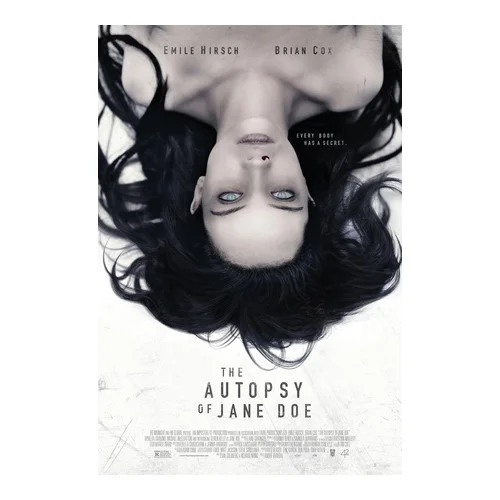
Film d’horreur surnaturel britannico-américain, The Autopsy of Jane Doe est réalisé par le Norvégien André Øvredal, pour qui il constitue le premier long métrage en langue anglaise. Produit par IM Global et Impostor Pictures, avec Fred Berger et Brian Kavanaugh-Jones à la production, le film est écrit par Ian B. Goldberg et Richard Naing. Il réunit Brian Cox et Emile Hirsch dans les rôles principaux, face au corps interprété par Olwen Catherine Kelly. Présenté en première mondiale au Festival international du film de Toronto le 9 septembre 2016, il sort aux États-Unis le 21 décembre 2016. Dans le cadre confiné d’une morgue familiale, The Autopsy of Jane Doe convoque le mystère, l’histoire de la persécution des femmes et une horreur d’autant plus efficace qu’elle naît du silence et de l’immobile.
Tommy Tilden, légiste chevronné, et son fils Austin, qui gère avec lui leur morgue et crématorium de Grantham, en Virginie, reçoivent en pleine nuit un cadavre non identifié — une femme inconnue retrouvée à moitié enfouie dans les fondations d’une maison où s’est produit un massacre. Le shérif leur demande d’en déterminer la cause du décès avant l’aube. L’autopsie commence comme une procédure de routine, mais les deux hommes ne tardent pas à se heurter à des contradictions impossibles : aucune blessure externe visible, mais des organes internes lacérés, des os fracturés aux poignets et aux chevilles, une langue sectionnée, des poumons noircis, et des tatouages gravés à l’intérieur de la peau. Chaque nouvelle découverte anatomique soulève davantage de questions, tandis que des phénomènes inexplicables commencent à se produire dans la morgue. La Jane Doe garde ses secrets — et semble ne pas vouloir les laisser partir vivants.
Après le succès de Trollhunter (2010), film de found footage norvégien acclamé par la critique, Øvredal souhaite démontrer l’étendue de sa palette et s’affranchir de l’esthétique de la caméra portée. C’est le visionnage de Conjuring de James Wan qui le convainc de revenir aux fondamentaux du cinéma d’horreur classique. Il est alors envoyé le scénario de Goldberg et Naing par son agence et s’y attache immédiatement. Le tournage a lieu au printemps 2015, en grande partie à Home Farm, dans le Kent (Angleterre), qui sert de décor extérieur pour la demeure des Tilden, la morgue étant entièrement reconstituée en studio. Øvredal choisit de faire appel à une vraie actrice, Olwen Catherine Kelly, plutôt qu’à des prothèses pour incarner le corps de Jane Doe, afin d’assurer la viscéralité des très nombreux gros plans de l’autopsie. Pratiquant le yoga, Kelly parvient à contrôler respiration et mouvements de manière à paraître inerte, dans ce que le réalisateur considère comme le rôle le plus difficile du film. La photographie est assurée par Roman Osin, et la bande originale composée par Danny Bensi et Saunder Jurriaans.
Accueilli très favorablement à Toronto, The Autopsy of Jane Doe bénéficie notamment des éloges de l’écrivain Stephen King. Sur Rotten Tomatoes, il obtient 86 % d’avis positifs sur la base de 110 critiques, avec une note moyenne de 7/10. La synthèse critique du site souligne que le film déjoue les attentes suscitées par son titre pour livrer un thriller intelligent et subtilement effrayant. Sur Metacritic, il récolte un score de 65/100. La presse britannique et américaine lui accorde plusieurs critiques quatre étoiles, saluant la construction progressive de la tension, la sobriété des effets spéciaux, la solidité du duo Cox-Hirsch et la dimension allégorique du récit — lu par plusieurs critiques comme une méditation sur la souffrance invisible infligée aux femmes à travers les siècles. The Autopsy of Jane Doe s’impose comme l’un des films d’horreur les plus remarqués de 2016, aux côtés de The Witch et Don’t Breathe, et confirme Øvredal comme l’un des réalisateurs de genre les plus prometteurs de sa génération.
A British-American supernatural horror film, The Autopsy of Jane Doe was directed by Norwegian filmmaker André Øvredal, marking his first English-language feature. Produced by IM Global and Impostor Pictures, with Fred Berger and Brian Kavanaugh-Jones producing, the film was written by Ian B. Goldberg and Richard Naing. It stars Brian Cox and Emile Hirsch, opposite the body portrayed by Olwen Catherine Kelly. The film had its world premiere at the Toronto International Film Festival on September 9, 2016, and was released in the United States on December 21, 2016. Set almost entirely within the confines of a family-run morgue, The Autopsy of Jane Doe mines its horror from silence and stillness, weaving together medical mystery, the history of violence against women, and a dread that steadily accumulates rather than announces itself.
Tommy Tilden, a seasoned coroner, and his son Austin run their family morgue and crematorium in Grantham, Virginia. Late one night, they receive an unidentified corpse — a woman found half-buried beneath the foundations of a home where a massacre has taken place. The sheriff asks them to determine the cause of death before morning. The autopsy begins as routine, but the two men quickly encounter contradictions that defy medical science: no external wounds, yet the internal organs show signs of laceration; shattered bones at the wrists and ankles; a severed tongue; blackened lungs; and markings tattooed inside the skin itself. Each anatomical discovery raises more questions than it answers, while inexplicable phenomena begin occurring throughout the morgue. Jane Doe is keeping her secrets — and seems unwilling to let them leave alive.
Following the international success of Trollhunter (2010), his acclaimed Norwegian found-footage film, Øvredal sought to demonstrate a broader directorial range and move away from the aesthetic of handheld immediacy. It was watching James Wan's The Conjuring that convinced him to pursue a return to classical horror filmmaking. His agency then sent him the Goldberg and Naing script, to which he was immediately drawn. Principal photography took place in spring 2015, largely at Home Farm in Selling, Kent, which served as the exterior and domestic setting for the Tilden home, while the morgue itself was entirely built on a studio set. Rather than using prosthetics for the autopsy sequences, Øvredal cast a real actress, Olwen Catherine Kelly, whose background in yoga gave her the physical control required to remain convincingly still and regulate her breathing through the film's many close-up examination scenes — a performance Øvredal has described as the most challenging in the film. Cinematography was handled by Roman Osin, with the original score composed by Danny Bensi and Saunder Jurriaans.
Warmly received at Toronto — where writer Stephen King publicly praised it — The Autopsy of Jane Doe holds an 86% approval rating on Rotten Tomatoes based on 110 reviews, with an average score of 7 out of 10. The site's critical consensus notes that the film confounds the gruesome expectations of its title to deliver a smart and suggestively unsettling thriller. On Metacritic, it scores 65 out of 100. British and American press alike awarded it multiple four-star notices, praising its measured build of tension, its restrained use of special effects, the strength of the Cox-Hirsch pairing, and the film's allegorical dimension — widely read as a meditation on the invisible suffering inflicted on women across centuries. The Autopsy of Jane Doe stands as one of the most acclaimed horror films of 2016, alongside The Witch and Don't Breathe, and confirmed Øvredal as one of the most compelling genre filmmakers of his generation.