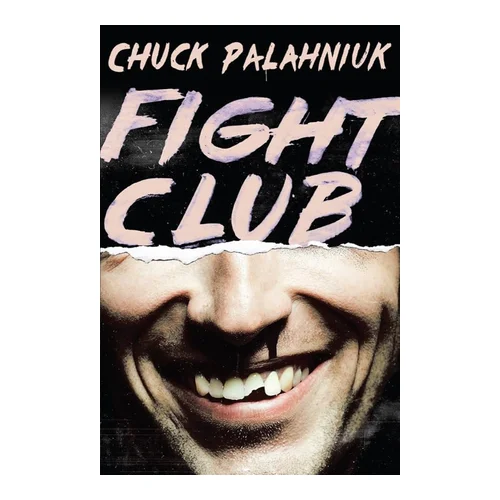
Premier roman publié de Chuck Palahniuk, Fight Club paraît aux États-Unis en août 1996 chez W. W. Norton, avant d’être traduit par Freddy Michalski et publié en France chez Gallimard en 1999. Roman postmoderne et satirique, il s’inscrit dans la tradition de la fiction américaine transgressive en portant une critique radicale de la société de consommation, de la masculinité contemporaine et de l’aliénation identitaire. À travers une écriture brute, fragmentée et hypnotique, Palahniuk impose d’emblée une voix littéraire entièrement singulière.
Un cadre anonyme, insomniaque et profondément désenchanté par son existence standardisée, fréquente des groupes de soutien pour malades graves afin de trouver le sommeil et combler un vide existentiel. Sa rencontre avec Marla Singer, une intruse qui fréquente ces mêmes groupes sans y être concernée, vient fragiliser cet équilibre précaire. Puis il croise Tyler Durden, projectionniste, serveur et anarchiste charismatique, avec qui il fonde un club de combats clandestins dans les sous-sols de bars américains. Les hommes qui le rejoignent y affrontent la douleur physique comme exutoire à leur mal-être profond. Ce cercle, d’abord vécu comme un espace de libération, évolue progressivement vers une organisation souterraine aux ambitions radicales, le Projet Chaos, dont les activités visent à déstabiliser les fondements mêmes de la société de consommation. Le roman explore l’aliénation, la dissociation identitaire et le rejet des valeurs matérialistes, sans révéler les ressorts de son intrigue avant son dénouement fracassant.
L’écriture de Fight Club est indissociable de la trajectoire personnelle de Palahniuk. Né en 1962 à Pasco (Washington), diplômé de l’Université de l’Oregon, il rédige le texte dans ses carnets de travail pendant les temps morts de son emploi de mécanicien, après que les éditeurs eurent refusé son premier manuscrit, Monstres invisibles. Il conçoit Fight Club comme une réponse provocatrice à ce rejet, écrivant d’abord ce qui deviendra le chapitre 6 sous forme de nouvelle avant d’en faire un roman complet. Le style qui en résulte est délibérément abrupt, non linéaire et percutant : phrases courtes, répétitions incantatoires, adresses directes au lecteur, narration à la première personne instable. Cette écriture fragmentée mime la désintégration psychique du narrateur et constitue l’une des signatures formelles les plus reconnaissables de l’œuvre. Fight Club est le premier roman publié de Palahniuk, bien que Monstres invisibles ait été écrit antérieurement. Il inaugure une bibliographie construite autour de personnages fracturés et d’une Amérique désenchantée.
Lors de sa publication en 1996, Fight Club passe largement inaperçu commercialement et ne rencontre pas d’écho critique immédiat significatif. C’est l’adaptation cinématographique de David Fincher en 1999, avec Brad Pitt et Edward Norton, qui propulse les ventes du roman et révèle Palahniuk au grand public mondial. En France, Gallimard publie une première édition en 1999, puis une édition de poche dans la collection Folio, régulièrement rééditée depuis. Le roman acquiert progressivement un statut culte, notamment auprès de la génération X et des lecteurs de fiction transgressive, et figure aujourd’hui parmi les œuvres de référence de la littérature américaine contemporaine. Il a engendré deux suites en comics : Fight Club 2 (2016) et Fight Club 3 (2019), toutes deux scénarisées par Palahniuk et publiées chez Dark Horse Comics, Fight Club 2 étant dessiné par Cameron Stewart. Le roman a été traduit dans de nombreuses langues et demeure le titre le plus connu d’une bibliographie qui compte également Survivant, Berceuse et Choke.
Fight Club, Chuck Palahniuk's debut novel published in 1996 by W. W. Norton in the United States, is a work of postmodern, satirical fiction. Translated into French by Freddy Michalski and published by Gallimard, the novel is set in contemporary America and follows an unnamed narrator — a sleepless, consumption-driven office worker — who falls under the spell of the charismatic Tyler Durden. A brutal meditation on male alienation, fractured identity, and nihilistic rebellion, Fight Club stands as a defining generational text in American transgressive literature.
An unnamed narrator, a young corporate employee at an automobile company, suffers from chronic insomnia and numbs himself with consumer goods in a carefully furnished apartment — the perfect embodiment of the modern consumer. To fill his inner void, he begins attending support groups for the terminally ill, where he unexpectedly finds emotional release. His routine is upended when he meets Tyler Durden, an anarchist soap-maker and movie projectionist whose philosophy of self-destruction captivates him entirely. Together, they found an underground fight club — a clandestine circle where men beat each other with bare fists to reclaim a raw sense of vitality. The club spreads rapidly across the United States, gradually morphing into a subversive organization with far more radical ambitions. Between the narrator, Tyler, and Marla Singer — a cynical woman encountered in the same support groups — volatile relationships form that shatter the protagonist's sense of his own identity.
In 1995, Palahniuk joined a Portland-based writing group that practiced a technique called "dangerous writing," developed by author Tom Spanbauer, which emphasizes minimalist prose drawn from painful personal experiences. Under this influence, he wrote an early draft of what would become Invisible Monsters, which was rejected by every publisher he submitted it to. He then wrote Fight Club, expanding a seven-page short story first published in the anthology Pursuit of Happiness in 1995. The novel was conceived as a direct response to that editorial rejection and explores the broken connection between men and society. Its deliberately non-linear structure — with ellipses, flashbacks, and punchy aphoristic sentences — is a formal stylistic choice that mirrors the novel's thematic deconstruction.
Published on August 17, 1996, Fight Club was received positively and earned Palahniuk the 1997 Pacific Northwest Booksellers Association Award and the Oregon Book Award for Best Novel. Nevertheless, the book sold fewer than 5,000 copies upon release. It was David Fincher's 1999 film adaptation, starring Brad Pitt and Edward Norton, that brought the novel to a far wider audience. Though the film initially divided critics and underperformed at the box office, its DVD release made it a cult phenomenon, driving multiple reprintings of the novel. The cultural impact was such that real-life fight clubs appeared across the United States, including one on the Princeton University campus. Palahniuk later extended the universe with Fight Club 2 (2016) and Fight Club 3 (2019), two graphic novels illustrated by Cameron Stewart.