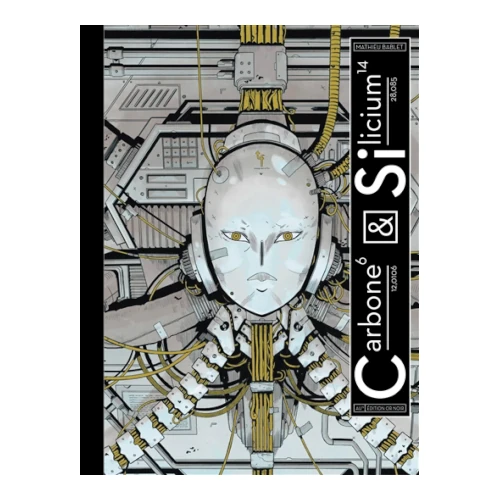


Carbone & Silicium est un one-shot de science-fiction post-apocalyptique écrit, dessiné et colorisé par Mathieu Bablet, publié le 28 août 2020 aux éditions Ankama dans la collection Label 619, avec la participation aux couleurs de Carla de Almeida et Cathy Fernandez. Album cartonné de 272 pages, il constitue la deuxième grande œuvre de science-fiction de Bablet après Shangri-La (2016), dont il vendit plus de 110 000 exemplaires. Récompensé par le Prix de la BD Fnac France Inter 2021 et le Prix Utopiales BD 2021, et finaliste du Grand Prix de la Critique 2021, Carbone & Silicium s’impose immédiatement à sa sortie comme l’une des œuvres majeures de la BD francophone contemporaine et un jalon dans la représentation de l’intelligence artificielle dans le neuvième art.
En 2046, la Tomorrow Foundation donne naissance à Carbone et Silicium dans un cocon protecteur situé dans la Silicon Valley, sous la direction de Noriko Ito, chercheuse spécialisée en intelligence artificielle. Ces deux humanoïdes sont les prototypes d’une nouvelle génération de robots destinés à prendre soin d’une population humaine vieillissante. Avides de découvrir le monde extérieur, ils finissent par s’évader — et se séparent. L’album suit ensuite leurs trajectoires parallèles sur plus de 270 ans, à mesure que la planète s’enfonce dans les catastrophes climatiques, les bouleversements politiques et la désagrégation du lien social. Carbone et Silicium traversent chacun à leur façon ce long effondrement et cette lente reconstruction, cherchant leur place dans un monde humain qui ne sait plus ce qu’il veut être, témoin de ce qu’un être mortel ne pourrait jamais observer — la totalité d’une civilisation qui se détruit et se réinvente.
Bablet a consacré quatre années à l’élaboration de Carbone & Silicium, partant du désir de croiser deux thématiques qui se sont révélées indissociables : la collapsologie et la robotique. Ses propres mots résument le projet — avec une vie allongée à l’infini, les deux androïdes deviennent les témoins idéaux de l’effondrement d’un monde, voyant ce qu’aucun humain mortel ne pourrait voir. L’album dialogue explicitement avec les grands textes de la SF robotique — Asimov, Blade Runner, Ghost in the Shell — pour mieux les déplacer : ici, l’humanité n’est pas le modèle vers lequel les robots doivent tendre, et aucun sauveur ne viendra. Le style graphique de Bablet — résolument personnel, combinant une ligne claire à des couleurs riches et des compositions de planche d’une densité pictural rare — crée une esthétique immédiatement reconnaissable, à la fois contemplative et politiquement engagée, héritière autant de Moebius que du cinema de science-fiction américain des années 1970-80.
Paru en tête des ventes dès sa sortie, Carbone & Silicium reçoit un accueil critique exceptionnel. BDZoom salue un album qui « prend à bras le corps avec brio la quasi totalité des interrogations actuelles » sur l’écologie, le transhumanisme et le lien social. Comixtrip le qualifie de « chef-d’œuvre SF » et de « délice d’intelligence ». Les prix de la BD Fnac France Inter et des Utopiales 2021 confirment une reconnaissance à la fois populaire et institutionnelle. Le livre est traduit dans plusieurs langues, s’imposant comme l’une des œuvres de SF francophones les plus exportées de sa génération. Carbone & Silicium s’inscrit dans une bibliographie cohérente qui comprend La Belle Mort (2011), Adrastée (2013-2014) et Shangri-La (2016), confirmant Bablet comme la voix française la plus singulière de la science-fiction en bande dessinée.
Carbone & Silicium is a post-apocalyptic science-fiction one-shot written, drawn, and coloured by Mathieu Bablet, published on August 28, 2020 by Ankama under the Label 619 imprint, with colour assistance from Carla de Almeida and Cathy Fernandez. A 272-page hardcover album, it is Bablet’s second major science-fiction work following Shangri-La (2016), which sold over 110,000 copies. Awarded the Prix de la BD Fnac France Inter 2021 and the Prix Utopiales BD 2021, and shortlisted for the Grand Prix de la Critique 2021, Carbone & Silicium established itself immediately upon publication as one of the defining works of contemporary French comics and a landmark in the depiction of artificial intelligence in the ninth art.
In 2046, the Tomorrow Foundation brings Carbone and Silicium to life in a protective incubator in Silicon Valley, under the supervision of researcher Noriko Ito, a specialist in artificial intelligence. These two humanoids are the prototypes of a new generation of robots designed to care for an aging human population. Hungry to discover the outside world, Carbone & Silicium eventually escape — and are separated. The album then follows their parallel trajectories across more than 270 years, as the planet sinks into climate catastrophe, political upheaval, and the disintegration of social bonds. Carbone and Silicium each navigate this long collapse and slow reconstruction in their own way, searching for their place in a human world that no longer knows what it wants to be — witnesses to what no mortal being could ever observe: the full arc of a civilisation destroying and reinventing itself.
Bablet spent four years developing Carbone & Silicium, beginning with the desire to weave together two themes that proved inseparable: collapsology and robotics. In his own words, by granting the two androids indefinitely extended lifespans, he made them ideal witnesses to civilisational collapse — seeing what no mortal human could ever see. The album explicitly engages with the canonical texts of robot science fiction — Asimov, Blade Runner, Ghost in the Shell — only to displace them: here, humanity is not the model toward which robots should aspire, and no saviour is coming. Bablet’s graphic style — distinctly personal, combining clear line work with rich colours and pictorially dense page compositions — creates an immediately recognisable aesthetic that is at once contemplative and politically engaged, heir to both Moebius and 1970-80s American science-fiction cinema.
Reaching the top of the sales charts immediately on release, Carbone & Silicium received exceptional critical acclaim. BDZoom hailed an album that « tackles with brilliance virtually every pressing question of our time » on ecology, transhumanism, and social connection. Comixtrip called it a « SF masterpiece » and a « delight of intelligence. » The Prix de la BD Fnac France Inter and the Utopiales prize in 2021 confirmed both popular and institutional recognition. Translated into several languages, the book has become one of the most widely exported French-language SF works of its generation. Carbone & Silicium sits within a coherent bibliography including La Belle Mort (2011), Adrastée (2013-2014), and Shangri-La (2016), confirming Bablet as the most singular French voice in science-fiction comics.