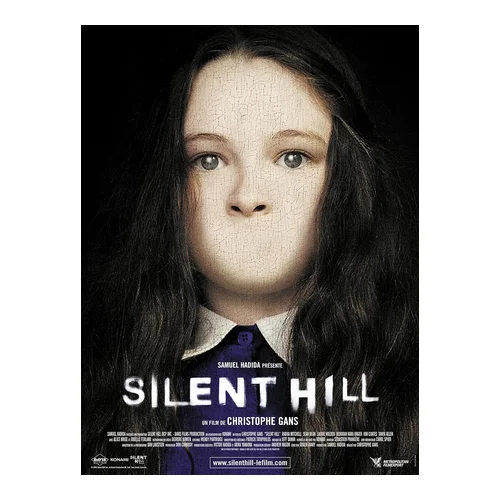
Silent Hill est un film d’horreur psychologique franco-canadien réalisé par Christophe Gans, sorti au Canada le 21 avril 2006 et en France le 26 avril 2006. Adaptation du jeu vidéo homonyme de Konami (1999), le film est écrit par Roger Avary et Nicolas Boukhrief sur une histoire développée par Gans et Avary, et produit par Samuel Hadida et Don Carmody pour Davis Films et Konami. Distribué en France par Metropolitan Filmexport et au Canada par Alliance Atlantis, ce long métrage de 126 minutes réunit Radha Mitchell, Sean Bean, Laurie Holden, Deborah Kara Unger, Kim Coates, Alice Krige et Jodelle Ferland. Adaptation visionnaire et profondément personnelle du matériau source, il s’impose rétrospectivement comme l’un des films d’horreur les plus ambitieux et les plus formellement singuliers du cinéma de genre des années 2000.
Rose Da Silva (Radha Mitchell) est mère d’une jeune fille adoptée, Sharon (Jodelle Ferland), qui souffre de somnambulisme et répète en dormant le nom d’une ville : Silent Hill. Déterminée à comprendre l’étrange mal dont souffre son enfant, Rose décide de l’emmener sur place contre l’avis de son mari Christopher (Sean Bean). Aux abords de la ville abandonnée de Virginie-Occidentale, un accident de voiture la plonge dans l’inconscience. À son réveil, Sharon a disparu. Rose entreprend alors une descente aux enfers à travers Silent Hill — ville enveloppée d’une brume de cendres oscillant entre un monde diurne désert et un « Autre Monde » de feu et d’obscurité peuplé de créatures déformées — pour retrouver sa fille, tandis qu’une secte fanatique hante les décombres et que la police montée Cybil Bennett (Laurie Holden) tente de la retrouver. Le récit entrelace plusieurs niveaux temporels et la vérité sur l’origine de Sharon se révèle progressivement, liée aux crimes commis par la communauté contre une enfant nommée Alessa.
Christophe Gans, auteur du Pacte des loups (2001) et fan déclaré de la franchise, consacre cinq ans à l’obtention des droits auprès de Konami — concurrencé notamment par Miramax, Paramount et la société de Tom Cruise. Pour convaincre l’éditeur japonais, il envoie une cassette vidéo dans laquelle il filme lui-même des scènes inspirées du jeu, montées sur la musique d’Akira Yamaoka. Konami lui accorde les droits. L’écriture du scénario débute en 2004 avec Roger Avary (scénariste de Pulp Fiction et Killing Zoe), assisté de Nicolas Boukhrief pour le texte français. Avary s’inspire de Centralia, Pennsylvanie — ville quasi-abandonnée au-dessus de laquelle brûle depuis quarante ans un incendie souterrain de mine de charbon — pour modéliser la géographie infernale de Silent Hill. Le tournage débute en avril 2005, principalement à Brantford et Hamilton (Ontario), sur des plateaux construits et des décors naturels reconvertis. Les décors sont signés Carol Spier (collaboratrice de David Cronenberg), les créatures conçues par le Franco-grec Patrick Tatopoulos. La quasi-totalité des monstres — infirmières décharnées, figurants à la démarche arthritique, Pyramid Head — sont joués par des danseurs professionnels en costumes prothétiques : Pyramid Head est interprété par Roberto Campanella dans un costume à cinq éléments nécessitant deux heures et demie de maquillage, avec des chaussures à semelle cachée de 38 cm le portant à près de deux mètres dix. La musique conjugue les compositions originales de Jeff Danna et les thèmes existants d’Akira Yamaoka, compositeur des jeux.
À sa sortie, Silent Hill obtient 29 % de critiques favorables sur Rotten Tomatoes, dont le consensus reconnaît les qualités visuelles mais dénonce le dialogue indigent, le scénario embrouillé et la durée excessive. Sur le plan commercial, le film dépasse néanmoins les 100 millions de dollars de recettes mondiales pour un budget de 50 millions — résultat honorable mais en dessous des attentes d’un blockbuster de divertissement de genre. La presse française est relativement plus indulgente, saluant la cohérence esthétique et la fidélité à l’atmosphère du jeu. La réception populaire dépasse largement la critique spécialisée : le film acquiert rapidement le statut d’œuvre culte auprès des fans du jeu vidéo et des amateurs d’horreur atmosphérique, réévalué au fil des années comme une des adaptations vidéoludiques les plus ambitieuses jamais portées à l’écran. Collider publie en 2025 un article le qualifiant de victime d’incompréhension critique à sa sortie. Silent Hill ouvre la voie à une suite, Silent Hill: Revelation (2012), sans Gans, qui sera reçue catastrophiquement (5 % sur Rotten Tomatoes), puis à Return to Silent Hill (2026) que Gans réalise lui-même — confirmant l’attachement indéfectible du cinéaste à la franchise.
Silent Hill is a French-Canadian psychological horror film directed by Christophe Gans, released in Canada on April 21, 2006, and in France on April 26, 2006. An adaptation of Konami's 1999 survival horror video game of the same name, the film was written by Roger Avary and Nicolas Boukhrief from a story developed by Gans and Avary, and produced by Samuel Hadida and Don Carmody for Davis Films and Konami. Distributed in France by Metropolitan Filmexport and in Canada by Alliance Atlantis, this 126-minute feature stars Radha Mitchell, Sean Bean, Laurie Holden, Deborah Kara Unger, Kim Coates, Alice Krige, and Jodelle Ferland. A visionary and deeply personal adaptation of its source material, it has been retrospectively recognized as one of the most formally ambitious horror films of the 2000s.
Rose Da Silva (Radha Mitchell) is the mother of an adopted daughter, Sharon (Jodelle Ferland), who suffers from sleepwalking episodes during which she repeatedly calls out the name of a town: Silent Hill. Determined to understand her child's affliction and against her husband Christopher's (Sean Bean) wishes, Rose drives Sharon to the abandoned West Virginia mining community. A car crash near the town's edge renders Rose unconscious; when she wakes, Sharon has vanished. Rose then descends into Silent Hill — a town shrouded in ash-gray fog oscillating between a deserted daytime state and a hellish Otherworld of fire and darkness populated by deformed creatures — to find her daughter, while a fanatical religious sect haunts the ruins and motorcycle officer Cybil Bennett (Laurie Holden) searches for Rose. The narrative weaves multiple temporal layers, gradually revealing the truth about Sharon's origins and her connection to a child named Alessa, a victim of the community's crimes.
Christophe Gans, director of Brotherhood of the Wolf (2001) and a devoted fan of the game franchise, spent five years pursuing the rights from Konami, competing against Miramax, Paramount, and Tom Cruise's production company. To convince the Japanese publisher, Gans filmed himself on his own dime in scenes inspired by the games, edited to Akira Yamaoka's music, and sent the tape to Konami, who awarded him the rights. The screenplay was developed from 2004 with Roger Avary (co-writer of Pulp Fiction and Killing Zoe), with Nicolas Boukhrief assisting on the French text. Avary drew inspiration from Centralia, Pennsylvania — a near-abandoned town above a coal-seam fire that has been burning underground for over forty years — as the cinematic model for Silent Hill's geography. Principal photography began in April 2005, shot primarily in Brantford and Hamilton, Ontario, on purpose-built stages and repurposed locations. Production design was by Carol Spier (a frequent David Cronenberg collaborator); creature design by French-Greek designer Patrick Tatopoulos. Virtually all the film's monsters — the emaciated nurses, the stumbling armless figures, Pyramid Head — were performed by professional dancers in full prosthetic costumes. Pyramid Head was portrayed by Roberto Campanella in a five-element costume requiring two and a half hours of makeup application, with hidden platform soles raising him to nearly seven feet. The score paired original compositions by Jeff Danna with existing themes by Akira Yamaoka, the games' composer.
Upon release, Silent Hill earned a 29% approval rating on Rotten Tomatoes, whose consensus acknowledged its visual qualities while faulting its dialogue, muddled plot, and excessive runtime. Commercially, the film crossed $100 million worldwide against a $50 million budget — a respectable result, though below the blockbuster expectations of its studio backers. French critics were somewhat more generous, crediting the film's atmospheric fidelity to the game. Popular reception consistently outstripped critical: the film rapidly acquired cult status among fans of the video game franchise and of atmospheric horror, and has been steadily reappraised since as one of the most ambitious video game adaptations ever made. The film spawned a sequel, Silent Hill: Revelation (2012), directed without Gans and received catastrophically (5% on Rotten Tomatoes), then Return to Silent Hill (2026), which Gans himself directed — confirming his enduring attachment to the franchise he had fought so hard to bring to the screen.