

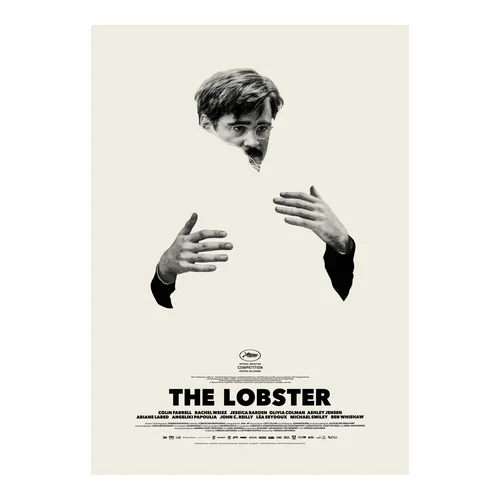


Quatrième long métrage de Yórgos Lánthimos, The Lobster est une comédie noire dystopique irlando-britannico-franco-hellène sortie en France le 28 octobre 2015, après avoir remporté le Prix du jury au Festival de Cannes la même année. Co-écrit par Lánthimos et son collaborateur de longue date Efthimis Filippou, le film marque le premier projet du réalisateur grec en langue anglaise et son accès à un casting international de premier plan : Colin Farrell, Rachel Weisz, Olivia Colman, Léa Seydoux, Ben Whishaw et John C. Reilly. Fable absurde et cruelle sur l’injonction au couple, The Lobster ausculte avec une froideur clinique la comédie sociale du désir, de la conformité et de la solitude.
Dans un futur proche, la loi interdit le célibat. David (Colin Farrell), quitté par sa femme après onze ans de vie commune, est conduit à l’Hôtel : un établissement où les célibataires disposent de quarante-cinq jours pour trouver un partenaire partageant avec eux au moins un trait en commun, sous peine d’être transformés en l’animal de leur choix. David a choisi le homard. À l’Hôtel, les résidents assistent à des pièces de théâtre vantant les mérites de la vie en couple, chassent les Solitaires — rebelles vivant dans les bois — pour allonger leur délai, et se soumettent à des rituels codifiés d’appariement. Lorsque David parvient à fuir et à rejoindre le camp des Solitaires, dirigé par une femme implacable (Léa Seydoux), il y rencontre une autre recluse myope (Rachel Weisz) avec laquelle naît un sentiment authentique — interdit précisément par les lois de cette communauté. Le film déploie ainsi deux tyrannies symétriques et également absurdes, renvoyant dos à dos la dictature du couple et celle de la solitude revendiquée.
The Lobster est la troisième collaboration au scénario de Lánthimos et Filippou, après Canine (2009) et Alps (2011). Le projet constitue pour Lánthimos un double franchissement : celui de la langue — il réalise pour la première fois en anglais — et celui de la géographie, le tournage se déroulant principalement en Irlande, dans un hôtel de la région de Cork et dans les forêts environnantes. La photographie froide et méticuleuse est assurée par Thimios Bakatakis, fidèle directeur de la photographie de Lánthimos depuis ses débuts. Le montage est confié à Yorgos Mavropsaridis, autre collaborateur historique. Colin Farrell, à contre-emploi radical — bedonnant, moustachu, maladroit —, a préparé son rôle en prenant du poids. Le budget du film est de 4 millions d’euros, modeste pour une coproduction réunissant l’Irlande, le Royaume-Uni, la France, la Grèce et les Pays-Bas.
Présenté en compétition officielle à Cannes le 15 mai 2015, The Lobster reçoit une réception critique excellente : 88 % sur Rotten Tomatoes, 80/100 sur Metacritic. La presse internationale salue unanimement la cohérence de l’univers, la direction d’acteurs et la pertinence de la satire sociale. Le film remporte le Prix du jury cannois, le LA Film Critics Association Award du meilleur scénario, et vaut au film une nomination aux BAFTA pour le meilleur scénario original de Filippou. Avec 18 millions de dollars de recettes mondiales pour un budget de 4 millions, il constitue un succès considérable à l’échelle de sa production. The Lobster s’impose comme le film charnière de la carrière de Lánthimos — celui qui l’introduit dans le système international et ouvre la voie à Mise à mort du cerf sacré (2017), La Favorite (2018) et Pauvres Créatures (2023).
The fourth feature film by Yórgos Lánthimos, The Lobster is an Irish-British-French-Greek black comedy dystopia released in France on October 28, 2015, after winning the Jury Prize at the Cannes Film Festival that same year. Co-written by Lánthimos and his longtime collaborator Efthimis Filippou, the film marks the director’s first project in English and his entry into an international star ensemble: Colin Farrell, Rachel Weisz, Olivia Colman, Léa Seydoux, Ben Whishaw, and John C. Reilly. An absurd and cruel fable about the imperative to couple, The Lobster dissects with clinical detachment the social comedy of desire, conformity, and solitude.
In the near future, the law forbids being single. David (Colin Farrell), left by his wife after eleven years together, is brought to the Hotel: an establishment where single people have forty-five days to find a partner who shares at least one trait with them, or else be transformed into the animal of their choice. David has chosen the lobster. At the Hotel, residents attend theatrical performances extolling the virtues of coupled life, hunt Loners — rebels living in the woods — to extend their deadline, and submit to codified rituals of pairing. When David escapes and joins the Loners’ camp, led by a relentless woman (Léa Seydoux), he encounters another short-sighted recluse (Rachel Weisz) with whom genuine feeling arises — a feeling forbidden precisely by the laws of this community. The film thus deploys two symmetrical and equally absurd tyrannies, holding the dictatorship of the couple and that of the claimed solitude in perfect mutual contempt.
The Lobster is the third screenwriting collaboration between Lánthimos and Filippou, following Dogtooth (2009) and Alps (2011). The project represented a dual threshold for Lánthimos: language — directing in English for the first time — and geography, as filming took place primarily in Ireland, in a hotel in the Cork region and the surrounding forests. The cold, meticulous cinematography was handled by Thimios Bakatakis, Lánthimos’s cinematographer since his earliest work. Editing was entrusted to Yorgos Mavropsaridis, another longstanding collaborator. Colin Farrell, cast radically against type — overweight, mustachioed, awkward — gained weight specifically for the role. The film’s budget was €4 million, modest for a co-production bringing together Ireland, the United Kingdom, France, Greece, and the Netherlands.
Presented in official competition at Cannes on May 15, 2015, The Lobster received an outstanding critical response: 88% on Rotten Tomatoes and 80/100 on Metacritic. The international press unanimously praised the coherence of the film’s world-building, the direction of actors, and the sharpness of the social satire. The film won the Cannes Jury Prize and the LA Film Critics Association Award for Best Screenplay, while earning Filippou a BAFTA nomination for Best Original Screenplay. With $18 million in worldwide box office receipts against a $4 million budget, it was a considerable success at its scale. The Lobster stands as the pivotal film in Lánthimos’s career — the one that introduced him to the international system and paved the way for The Killing of a Sacred Deer (2017), The Favourite (2018), and Poor Things (2023).


