

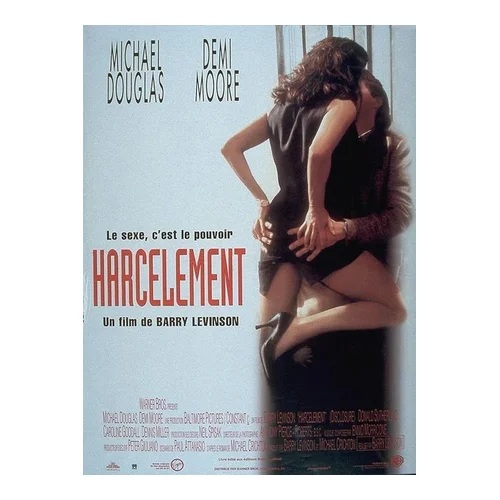


Sorti aux États-Unis le 9 décembre 1994 et en France le 8 février 1995 (Harcèlement), Disclosure est un thriller psychologique américain réalisé par Barry Levinson et écrit par Paul Attanasio, adapté du roman éponyme de Michael Crichton publié la même année. Produit par Baltimore Pictures et Constant C. Productions pour Warner Bros. avec un budget de 55 millions de dollars, le film réunit Michael Douglas, Demi Moore et Donald Sutherland dans un récit qui inverse les codes du thriller d’entreprise en plaçant une femme dans le rôle de l’harceleur et un homme dans celui de la victime. Co-produit par Crichton lui-même, il connaît un succès commercial considérable malgré une controverse intense autour de son propos.
Tom Sanders, directeur de la production chez DigiCom — société high-tech de Seattle en plein essor, spécialisée dans la réalité virtuelle et les lecteurs CD-ROM —, s’attend à être promu lors d’une fusion imminente. C’est finalement son ex-maîtresse, Meredith Johnson, ambitieuse et froide, qui hérite du poste de vice-présidente. Le soir même de sa nomination, elle convoque Tom seul dans son bureau et tente de le séduire. Il repousse ses avances. Le lendemain, elle dépose une plainte pour harcèlement sexuel contre lui, soutenue par l’avocat de l’entreprise. Tom, dont la vie familiale et professionnelle s’effondre, décide de porter l’affaire en médiation — et découvre bientôt que l’accusation masque une manipulation bien plus vaste : la dissimulation d’un défaut technique majeur dans un produit phare de la société, dont Meredith cherche à faire porter la responsabilité sur lui. L’enquête de Sanders le conduit dans les archives virtuelles de l’entreprise, accessibles via un environnement de réalité virtuelle — sequences conçues par Industrial Light & Magic qui constituent l’une des premières représentations grand public de navigation en cyberespace.
Crichton vend les droits du roman pour un million de dollars avant même sa publication. Miloš Forman est initialement attaché à la réalisation mais quitte le projet en raison de différends créatifs avec l’auteur. Barry Levinson et Alan J. Pakula sont alors en lice pour le remplacer ; Levinson est finalement choisi. Annette Bening est dans un premier temps choisie pour incarner Meredith Johnson, mais doit se retirer après avoir appris sa grossesse — c’est Demi Moore qui reprend le rôle. La photographie est assurée par Tony Pierce-Roberts, le montage par Stu Linder, et la musique composée par Ennio Morricone — une collaboration rare et inattendue entre le maître du score spaghetti-western et un thriller d’entreprise américain, qui confère au film une grandeur presque opératique.
À sa sortie, le film alimente des débats féministes intenses : accusé de participer au backlash anti-féministe en inversant les rapports de pouvoir, il est perçu par une partie de la critique et des associations comme un instrument idéologique visant à relativiser la réalité du harcèlement féminin. La réception critique est mitigée — presse spécialisée et généraliste saluent le rythme et les performances mais critiquent le caractère sensationnaliste du propos et son dérapage vers le thriller d’entreprise dans le second acte. Commercialement, le film est un succès : 81,3 millions de dollars aux États-Unis et 214 millions de dollars au total mondial, le plaçant parmi les plus gros succès de l’année 1994 — profitant pleinement de la ruée des studios sur les propriétés Crichton dans le sillage de Jurassic Park (1993).
Released in the United States on December 9, 1994 and in France on February 8, 1995 (Harcèlement), Disclosure is an American psychological thriller directed by Barry Levinson and written by Paul Attanasio, adapted from Michael Crichton’s novel of the same name published that same year. Produced by Baltimore Pictures and Constant C. Productions for Warner Bros. with a $55 million budget, the film brings together Michael Douglas, Demi Moore, and Donald Sutherland in a narrative that inverts the codes of the corporate thriller by placing a woman in the role of the harasser and a man in that of the victim. Co-produced by Crichton himself, it achieved considerable commercial success despite intense controversy around its premise.
Tom Sanders, head of production at DigiCom — a booming Seattle high-tech company specializing in virtual reality and CD-ROM drives — expects to be promoted during an imminent merger. Instead, his ex-mistress, the ambitious and icy Meredith Johnson, is given the vice-president position. That same evening, she summons Tom alone to her office and attempts to seduce him. He rejects her advances. The next day, she files a sexual harassment complaint against him, backed by the company’s lawyer. Tom, whose family and professional life collapses around him, decides to take the case to mediation — and soon discovers that the accusation masks a far larger manipulation: the concealment of a major technical flaw in a flagship product, for which Meredith is seeking to pin the blame on him. Sanders’s investigation leads him through the company’s virtual archives, accessible via a virtual reality environment — sequences created by Industrial Light & Magic that represent one of cinema’s earliest mainstream depictions of navigating cyberspace.
Crichton sold the film rights for $1 million before the novel was even published. Miloš Forman was initially attached to direct but left the project due to creative differences with the author. Barry Levinson and Alan J. Pakula were then in contention to replace him; Levinson was ultimately hired. Annette Bening was initially cast as Meredith Johnson but had to withdraw after learning she was pregnant — Demi Moore stepped in to take the role. Cinematography was handled by Tony Pierce-Roberts, editing by Stu Linder, and the score composed by Ennio Morricone — a rare and unexpected collaboration between the master of the spaghetti-western score and an American corporate thriller, lending the film an almost operatic grandeur.
On release, the film fueled intense feminist debates: accused of participating in the anti-feminist backlash by inverting power dynamics, it was seen by part of the press and advocacy groups as an ideological instrument aimed at relativizing the reality of workplace harassment against women. Critical reception was mixed — both trade and general press praised the pacing and performances while faulting the sensationalist nature of the premise and its drift toward a corporate thriller in the second act. Commercially, the film was a major success: $81.3 million in the United States and $214 million worldwide, placing it among the year’s biggest hits — fully capitalizing on the Hollywood rush to acquire Crichton properties in the wake of Jurassic Park (1993).


